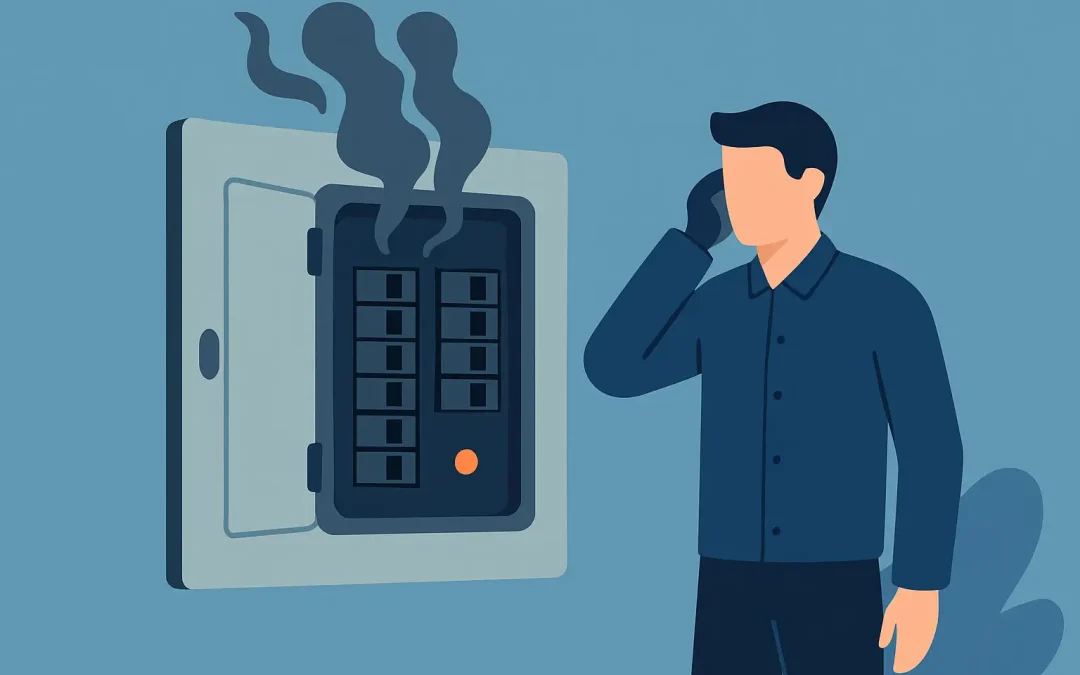
You walk past the garage or hallway and catch it – that sharp, plastic-like odor you usually only notice when something’s overheating. If the smell seems to be coming from your electrical panel, don’t chalk it up to “maybe the dryer” and move on. A burning smell at the breaker box is one of the clearest warning signs your electrical system is under stress, and in some cases, actively failing.
This is one problem where speed matters. The goal is not to “see if it goes away.” The goal is to make the home or building safe first, then figure out what caused it.
What a burning smell from the breaker box usually means
When someone reports a smell burning from breaker box, we think about heat – and what heat does inside a panel. Heat breaks down insulation, loosens connections further, and can turn a small issue into arcing (electricity jumping through air) or a melted bus bar (the metal that feeds power to breakers).
Sometimes the smell is obvious and strong. Other times it’s faint, especially early on. Either way, it’s usually tied to one of these situations.
1) A loose connection that’s heating up
Loose electrical connections are a top cause. A wire that isn’t tightly landed on a breaker or neutral bar creates resistance. Resistance creates heat. Heat creates that “hot plastic” smell.
This can happen after years of normal expansion and contraction, after prior work where a connection wasn’t torqued correctly, or when a circuit is running near its limit and vibrating slightly from load changes.
2) An overloaded circuit or breaker
A breaker can be doing its job and still smell “hot” if the circuit is consistently pushed hard. Think space heaters, hair tools, microwaves, air fryers, older garage freezers, or a commercial suite adding equipment on a circuit that wasn’t designed for it.
A breaker that repeatedly runs hot can discolor, weaken internally, and eventually fail to trip when it should. That’s why “it hasn’t tripped” is not a sign everything is fine.
3) A failing breaker
Breakers are mechanical devices with internal contacts and springs. They wear out. If a breaker is failing, it can develop poor contact where it clips onto the panel bus. That poor contact generates heat right at the breaker-panel connection, which can melt plastic and leave a persistent odor.
4) Arcing inside the panel
Arcing is a serious concern because it can happen without a large, obvious load. It’s often related to loose terminations, damaged conductor insulation, or corrosion. Arcing leaves a distinct smell – sometimes described as sharp, acrid, or “electrical.”
If you hear crackling, sizzling, or popping from the panel, treat it as an emergency.
5) Water intrusion or corrosion
Moisture in or near the panel can corrode connections and increase resistance. Even small corrosion points can create hot spots. In the Inland Empire, we also see garages and exterior-adjacent panels exposed to temperature swings and occasional water issues from irrigation, roof leaks, or stucco cracks.
6) Rodent or pest damage
Chewed insulation or nesting debris inside or near electrical equipment can create overheating and odor. Pest activity is especially common in garages, attics, and utility areas.
What to do immediately (and what not to do)
If you suspect the odor is coming from the electrical panel, take action in a calm, deliberate way.
Start by reducing risk. If it’s safe to approach the panel and you don’t see smoke or active sparking, you can turn off the main breaker to shut down power to the building. If you see smoke, flames, or hear loud arcing sounds, step away and call 911.
Avoid opening the panel cover. Homeowners and onsite staff shouldn’t remove the dead front (the interior metal cover). Even with the main off, parts of the panel may still be energized depending on the setup, and the risk of contact or arc flash isn’t worth it.
Also avoid “testing” by flipping individual breakers on and off repeatedly. If something is overheating, cycling power can make the failure worse.
If you need lights for safety after shutting power down, use flashlights rather than candles. A panel-related odor is not the moment to introduce an open flame.
Quick checks that can help pinpoint the source
Without taking anything apart, you can still gather useful information to tell an electrician.
Stand near the panel and see if the smell is strongest there or if it’s actually from a nearby appliance, outlet, or lighting circuit. Sometimes a failing receptacle or a melting cord makes the whole area smell “electrical,” and the panel gets blamed because it’s the most obvious electrical box in the room.
Look for visible signs around the panel door: discoloration, soot-like marks, warping, or melted plastic near breaker handles. If the panel is warm to the touch (not just slightly warm from ambient temperature, but noticeably warm), that’s a red flag.
If you have had any recent changes, mention them. New EV charger, new HVAC, a remodel, added refrigeration, a tenant turnover, or a new piece of shop equipment are common triggers that expose an existing weakness in the panel or service.
Why this can be urgent even if everything still “works”
Electrical issues often fail quietly – until they don’t.
A loose termination can run hot for a long time, slowly damaging insulation. A failing breaker can still supply power even as the connection point degrades. An overloaded circuit may never trip if the load is high but not high enough to cross the breaker’s trip curve.
The danger is that heat and arcing don’t always announce themselves with a dramatic outage. The smell is sometimes the first and only warning.
What a licensed electrician will typically check
Once the immediate situation is safe, diagnosis is about finding the heat source and correcting it to code.
A licensed electrician will typically inspect for melted insulation, damaged breaker stabs, discoloration on the bus, and signs of overheating at neutrals and grounds. They may measure load, verify conductor sizes, and check for improper double-taps or mixed conductor types where they don’t belong.
If the panel is older, the electrician will also consider whether the panel’s condition supports repair or whether replacement is the safer long-term call. Sometimes a single breaker replacement is appropriate. Other times, the panel has sustained damage where replacing individual parts does not restore safe contact pressure and heat dissipation.
In commercial settings, the evaluation often includes downtime planning. If a repair requires a full shutdown, a good contractor will walk you through what will be off, what needs to be protected, and how to restore operations safely.
“It depends” scenarios we see in real homes and buildings
Not every burning smell points to the same fix, and that’s why guessing can be expensive.
If the smell only happens when a specific appliance runs (like a dryer cycle or HVAC start-up), the issue may be on that circuit: a worn breaker, a loose termination, or an undersized conductor from an older installation.
If the smell is constant even with most loads off, the problem may be at the main lugs, the service conductors, or a deteriorated panel bus connection.
If you recently had electrical work done, it doesn’t automatically mean the work was “bad,” but it can mean the system is now being used differently. A new load can reveal an older weak point that was already borderline.
How to reduce the chances of this happening again
Once the immediate hazard is handled, prevention is mostly about capacity and connection quality.
If your panel is frequently full, uses a lot of tandem breakers, or you’re relying on power strips and extension cords to make your home function, that’s a sign your electrical infrastructure may be undersized for modern living. Panel upgrades and added circuits aren’t about luxury – they’re about reducing heat at connection points by giving loads the dedicated capacity they need.
For businesses, load planning matters just as much. Warehouses and light industrial spaces often evolve over time, adding equipment without revisiting the electrical distribution. A quick evaluation can identify which circuits are running hot, which panels are nearing limits, and where to add capacity before a failure disrupts operations.
When to call right now
Call for immediate help if the smell is strong, returns repeatedly, or is paired with flickering lights, buzzing from the panel, warm breaker faces, or breakers that won’t stay reset. If you’ve shut off the main and the smell persists, that’s even more reason to treat it as urgent.
If you’re in Rancho Cucamonga or the Inland Empire and want a licensed electrician to diagnose the issue, Potter Electric Company Inc. can help with safe troubleshooting, breaker and panel repairs, and upgrades when the panel has been compromised. You can book service at https://Potterelectricinc.com.
A helpful rule: electrical systems rarely “heal.” If your home or building is giving you a burning smell as feedback, believe it – and let that be the moment you choose safety and certainty over waiting.