The day you bring home an EV, your garage stops being just storage. It becomes part of your daily routine. And the first real decision most Inland Empire drivers run into is simple on the surface: do you want a plug-in charger you can unplug, or a hardwired charger that’s permanently installed?
If you’re comparing ev charger hardwired vs plug in options, the right answer depends on how fast you need to charge, what your electrical panel can handle, and how long you plan to stay in the home (or keep the EV). There are also code, permitting, and reliability differences that matter more than most people expect.
What “plug-in” and “hardwired” actually mean
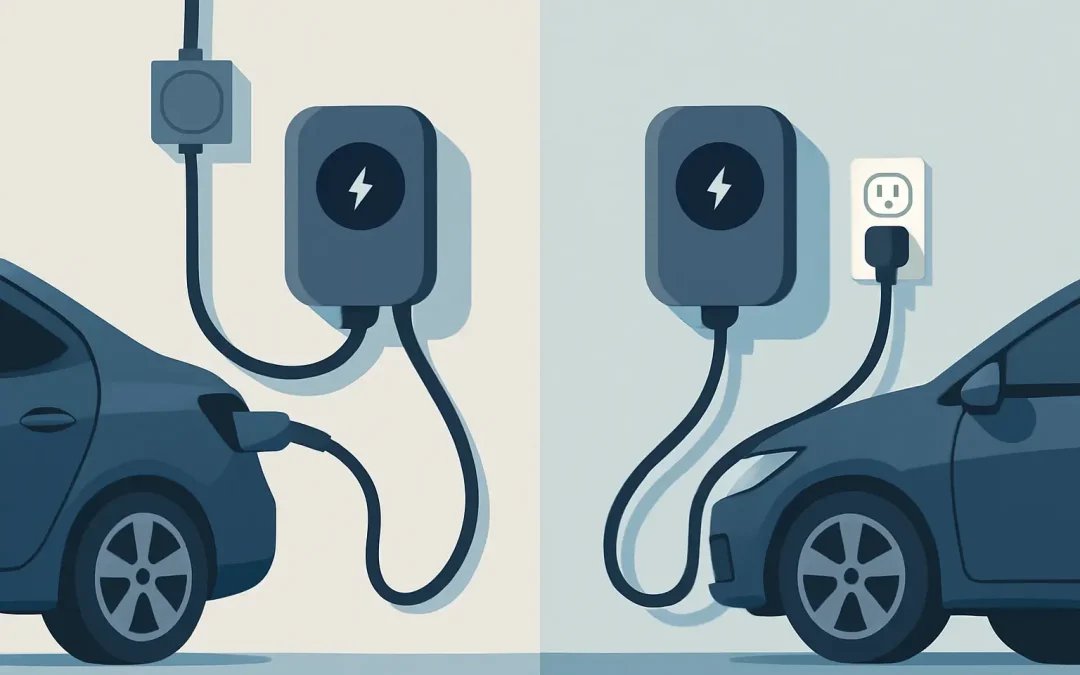
A plug-in EV charger (often called a Level 2 charger) is a wall-mounted unit that connects to a dedicated 240V receptacle, usually a NEMA 14-50 or 6-50 outlet. The charger itself isn’t “portable” in the sense of tossing it in your trunk every day, but it can be unplugged and moved without opening a junction box.
A hardwired EV charger is permanently connected to your electrical system. Instead of plugging into an outlet, it’s wired directly into a dedicated circuit and typically has an internal terminal block for the conductors.
Both can charge at Level 2 speeds. The difference is how they’re connected, and that affects safety, maximum output, and long-term dependability.
Charging speed: where hardwired usually wins
When people ask which is “better,” they’re often really asking, “Which one charges faster?” The charger’s maximum output and the circuit size determine charging speed, not just whether it’s plug-in or hardwired. That said, hardwired installations are more likely to support higher continuous charging rates.
Many plug-in chargers are set up on a 50A circuit (common with a NEMA 14-50). Because EV charging is considered a continuous load, the usable charging current must be limited to 80% of the circuit rating. On a 50A circuit, that usually means up to 40A charging.
Hardwired chargers can be installed on larger circuits when the home’s service and panel capacity allow it. A 60A circuit supports up to 48A continuous charging, which is a noticeable improvement for higher-mileage drivers or larger battery vehicles.
If you drive modestly and charge overnight, a 40A setup can be plenty. If you’re commuting long distances, sharing one charger between two EVs, or you want faster recovery after a low-battery day, hardwiring often provides more headroom.
Reliability and heat: the outlet is the weak link
A plug-in setup adds one more component that can loosen, wear, or overheat over time: the receptacle. EV charging runs for hours, several nights a week, at high continuous current. That’s very different from plugging in a dryer that cycles on and off.
The difference shows up in small ways at first. A receptacle that isn’t industrial-grade, a plug that isn’t fully seated, or terminals that weren’t torqued to spec can create resistance. Resistance creates heat. Heat leads to failures, nuisance shutdowns, or in the worst cases, damaged wiring or melting at the outlet.
Hardwiring removes the plug and receptacle from the equation. With fewer connection points, there’s less opportunity for heat buildup from a marginal contact. That’s a big reason many homeowners choose hardwired even when a plug-in option seems simpler.
Flexibility: where plug-in setups shine
Plug-in chargers are popular for a reason. If you’re renting, planning to move within a couple years, or you want the option to take the unit to a new house, plug-in makes that easier. You can unplug the charger and leave the receptacle for the next homeowner, or bring the charger with you if your next place already has the same outlet.
There’s also a practical service angle. If a charger ever needs replacement, a plug-in unit can often be swapped without an electrician opening the electrical connection. That doesn’t eliminate the need for a correctly installed circuit, but it can reduce downtime.
Just keep in mind that “flexible” shouldn’t mean “temporary.” If you’re charging nightly, the outlet, breaker, wire size, and installation quality still need to be right.
Cost and installation: what you’re really paying for
People often assume plug-in is always cheaper. Sometimes it is, especially if you already have the correct 240V receptacle in the right location and it’s on a properly sized, dedicated circuit.
But in many Inland Empire homes, the real cost driver is not the charger style. It’s the electrical work required to support it. That can include:
- Running a new 240V dedicated circuit to the garage or parking area
- Upgrading a panel or adding capacity if your current service is full
- Installing load management or a subpanel for better distribution
- Permitting and inspection requirements for code compliance
If your panel is older, crowded, or already supporting big loads like HVAC, an electric range, or a pool system, the project may require a thoughtful approach to keep everything safe and reliable.
Code and permitting: the “easy install” trap
EV chargers are not a DIY-friendly “just add an outlet” project. Because of the continuous load and the amperage involved, the installation needs to follow code requirements for conductor sizing, breaker sizing, correct receptacle rating, GFCI protection where required, and proper mounting and cable management.
Permitting is often a good thing, not a hassle. It creates a paper trail that the circuit was installed correctly and inspected, which can matter when selling the home or when insurance questions come up after an electrical incident.
Hardwired chargers are frequently permitted as a dedicated EVSE installation. Plug-in chargers can be permitted too, but problems occur when homeowners install a 14-50 receptacle using inexpensive parts intended for occasional use, not repeated high-load charging.
If you want a plug-in configuration, the safest approach is treating the receptacle as an essential component, not an accessory. The right receptacle, correct box, correct strain relief, correct torque, and correct breaker protection matter.
Day-to-day convenience: small differences that add up
A hardwired charger typically looks cleaner. The conduit run can be designed for the wall layout, the unit can be positioned for the easiest cable reach, and you don’t have an outlet and plug sticking out behind it.
Plug-in chargers can be just as neat when planned well, but the outlet location becomes a design constraint. If the receptacle ends up behind the charger where the cord is bent or where the plug is hard to access, it can lead to wear and frustration.
Also consider what happens when you reorganize your garage, park a different vehicle, or add a second EV. A well-placed hardwired unit is built around your routine. A plug-in setup gives you options, but only if the outlet location and circuit are planned with that future in mind.
Safety-first decision points that matter in real homes
If you’re trying to decide between ev charger hardwired vs plug in, these are the practical factors that usually determine the best fit:
If you want the highest charging output your home can support, hardwired is usually the straightforward choice because it can be paired with higher-amp circuits when your panel has capacity.
If you want to take the charger with you later, plug-in is appealing, but the outlet must be installed specifically for EV charging duty, not as a generic “RV outlet” shortcut.
If your electrical panel is already at its limits, either option may require a panel upgrade, a load calculation, or load management. In that case, choosing the charger connection method is secondary to making sure your electrical infrastructure is ready.
If your garage outlet would be exposed to bumps, storage items, or frequent plugging and unplugging, hardwiring can reduce wear and help keep the connection stable.
What we recommend for many Inland Empire homeowners
For drivers who charge most nights, want a clean look, and prefer fewer failure points, hardwired is often the best long-term setup. It’s the “set it and forget it” approach when installed on a properly sized dedicated circuit.
For homeowners who expect to move, or who want the option to swap equipment without touching the wiring, a plug-in installation can be a great solution as long as it’s built to handle the continuous load. The key is treating the receptacle and circuit like mission-critical equipment, not a convenience outlet.
If you’re not sure what your panel can support or where the charger should go for the smoothest daily use, a quick on-site evaluation usually clears things up fast. A licensed electrician can confirm available capacity, the right breaker and wire size, and the cleanest routing to the charger location.
If you’re in Rancho Cucamonga or elsewhere in the Inland Empire and want a safety-first EV charger installation with clear communication and dependable scheduling, Potter Electric Company Inc. can help you choose the right setup and install it to code.
The best charger is the one you don’t have to think about at 10 p.m. on a work night – it just charges safely, consistently, and at the speed your life actually needs.