You can usually spot a rushed recessed lighting job from the driveway – uneven circles on the ceiling, hot spots on the counter, shadows where you need light most, and switches that never seem to match how you use the room. Done correctly, recessed LEDs feel almost invisible. The space just looks brighter, cleaner, and more comfortable.
This guide walks through LED recessed lighting installation the way a licensed electrician thinks about it: light quality first, then layout, then the wiring and code details that keep the job safe and dependable. If you are in Rancho Cucamonga or anywhere in the Inland Empire and want a clean, to-code install without surprises, you can also book with Potter Electric Company Inc. and we will help you plan it properly.
What makes LED recessed lights different (and better)
Recessed cans used to mean heat, big housings, and bulbs that burned out at the worst time. LED recessed fixtures changed that. They run cooler, use far less power, and the better ones hold their color and brightness for years.
The trade-off is that LED fixtures are more sensitive to compatibility. The wrong dimmer can cause flicker, strobing, or a limited dimming range. And because LEDs last so long, you want to get the trim style, color temperature, and placement right the first time. A “good enough” layout can bother you for the next decade.
Plan the lighting like you plan furniture
Most recessed lighting problems are not electrical problems – they are planning problems. Before any holes are cut, decide what the light needs to do in that room.
Start with the purpose of the room
A kitchen needs task lighting on counters and a balanced wash over the whole space. A living room often needs flexible layers so you can go bright for cleaning and soft for evenings. Hallways and entries need safe, shadow-free paths. Offices need glare control so you are not fighting reflections on screens.
Once the purpose is clear, you can choose how many fixtures you need and where they go.
Spacing depends on ceiling height and beam angle
There is no single magic number for spacing. It depends on ceiling height, lumen output, and how wide the fixture throws light.
As a practical starting point, many homes land around 4 to 6 feet between fixtures on an 8-foot ceiling, then adjust from there based on what the room needs. Taller ceilings or narrower beam angles often need either more fixtures or better placement to avoid scallops and dark zones.
Pay attention to where shadows happen
Recessed lights placed in the wrong spot can put your body between the light and your work. In kitchens, lights that sit behind you while you face the counter can cast shadows right where you chop and prep. In bathrooms, a single recessed light centered overhead can create harsh shadows under eyes and chin.
That is why many bathrooms do best with a mix: recessed for overall light plus dedicated vanity lighting for the face. Kitchens often do best with recessed lights positioned to light the counter surface, not just the walkway.
Choose the right fixtures before installation day
“LED recessed light” can mean a lot of different products. Choosing the right type up front avoids rework and performance issues.
Canless wafers vs. traditional housings
Canless wafer lights are thin, quick to install, and great when you have tight ceiling space. Traditional housings can be useful when you want specific optics, higher-end trims, or you are matching an existing system.
Either can work well. The deciding factors are clearance, insulation conditions, and the look you want.
IC rating and airtight matters in real homes
If there is insulation in the ceiling cavity, you typically want IC-rated fixtures that are approved for direct contact with insulation. In many homes, airtight rated fixtures are also a big deal because leaky ceilings can waste conditioned air and introduce drafts.
This is one of those areas where “it fits” is not the same as “it is correct.” Ratings exist for safety and performance, and they matter.
Color temperature: pick it once, enjoy it for years
Color temperature affects how every surface in the room looks. Many homeowners like 2700K to 3000K for living spaces because it feels warm and comfortable. Kitchens, garages, and offices often lean toward 3500K to 4000K for a clearer, more task-forward feel.
If you mix temperatures across adjacent rooms, you will notice. If you are unsure, choose fixtures with selectable CCT (a built-in switch that lets you set the color) so you are not locked into a guess.
Dimming and drivers: where flicker is born
A lot of “bad LED” complaints are really dimmer mismatch complaints. The fixture driver and the wall dimmer have to play nicely together. Some LEDs require specific dimmer types, and older dimmers that worked with incandescent bulbs can cause visible flicker with LEDs.
When we plan LED recessed lighting installation, we look at the whole system – fixture, driver, dimmer, and load – so the result feels smooth and stable.
How a safe LED recessed lighting installation typically works
Every house is different, but the workflow is fairly consistent when the job is being done cleanly and to code.
1) Confirm power capacity and switching plan
Before adding a new lighting load, we confirm what circuit will feed it and whether it is appropriate to extend. We also plan switch locations, 3-way switching for halls or large rooms, and whether separate zones make sense.
Zoning is one of the best quality-of-life upgrades. For example, a kitchen may work better with one switch for perimeter/counter lighting and another for general lighting.
2) Locate joists, ducts, and plumbing before cutting
Cutting holes first and figuring it out later is how ceilings get patched. We locate framing, HVAC, plumbing vents, and other obstacles. This matters even more in remodels where surprises are common.
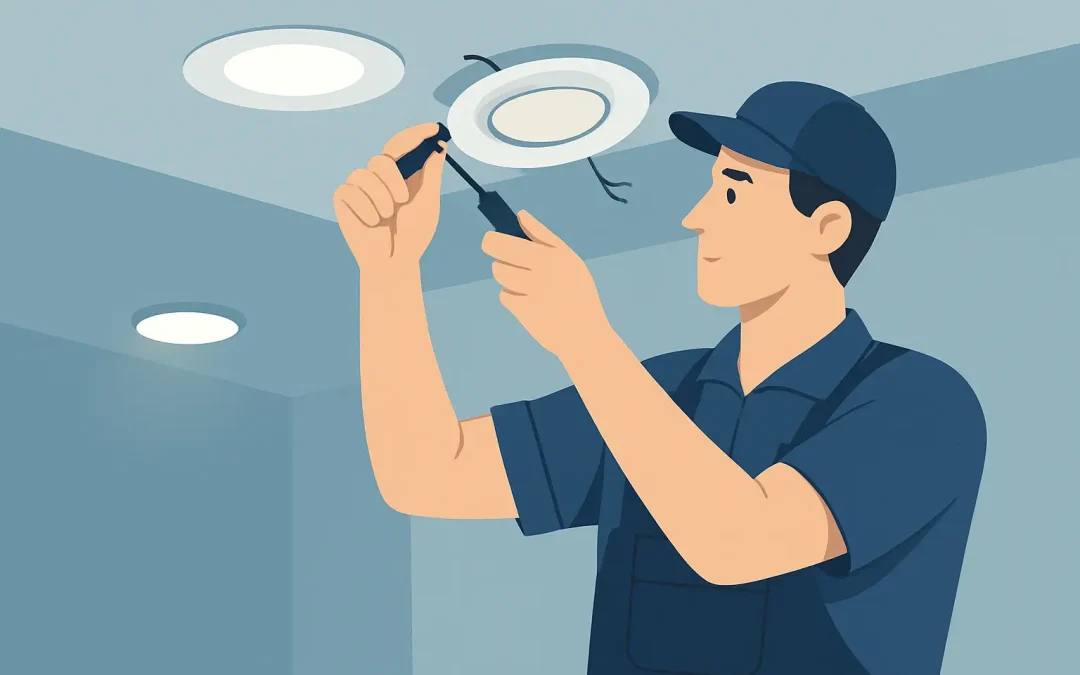
3) Cut precise openings and secure the fixture correctly
Recessed trims show everything. If holes are oversized or uneven, the ceiling will always look a little off. Fixtures also need to be supported the right way – not dangling on wiring or resting loosely in the drywall.
4) Run cable, make connections in accessible boxes, and bond/ground properly
Electrical connections must be made in approved boxes and remain accessible. Grounding is not optional. Proper cable support and protection is part of what separates a professional install from a “it works for now” install.
5) Install compatible dimmers and test under real conditions
Testing means more than flipping the switch once. We test at different dim levels, check for flicker or buzzing, confirm consistent color, and make sure each zone behaves the way you expect.
Remodel vs. new construction: why the approach changes
New construction is usually straightforward because the ceiling is open and the wiring is planned before drywall. Remodel installations often require fishing cable, working around insulation, and minimizing drywall cuts.
In many occupied homes, the goal is not only a working result – it is a clean result. That means protecting flooring, controlling dust, and leaving the space looking like the lights were always meant to be there.
When DIY is risky (and when it is simply not worth it)
Some homeowners are comfortable swapping a fixture or replacing a dimmer. Full LED recessed lighting installation is different because it involves cutting structural surfaces, routing wiring through concealed spaces, and meeting code requirements around junction boxes, grounding, insulation contact ratings, and circuit loading.
If you have an older home with aging wiring, frequent breaker trips, warm switch plates, or lights that already flicker, adding new fixtures can expose bigger issues. The safer move is to address the electrical foundation first – sometimes that means breaker work, dedicated circuits, or even a panel upgrade depending on the home’s load and condition.
And in commercial spaces, recessed lighting changes often tie into occupancy sensors, emergency egress requirements, ceiling types, and keeping operations running. Planning matters as much as the install.
Common results homeowners want – and how to get them
Most clients are after a few specific outcomes.
If you want a kitchen that feels brighter without feeling harsh, focus on even coverage and choose a warmer-neutral color temperature around 3000K to 3500K, then dim it for evenings. If you want a living room that can shift from movie night to cleaning day, split the lights into zones and use quality dimmers. If you are updating a hallway or entry for safety, aim for shadow-free paths and avoid placing fixtures where beams are blocked by soffits or tall cabinets.
The best part is that good recessed lighting does not call attention to itself. It just makes the house feel more finished.
LED recessed lighting installation costs: what changes the price
Pricing depends on access and complexity. A single-story home with an accessible attic is usually faster than a tight multi-story run with limited access. The number of zones, the type of fixtures, whether new switches are added, and how much patching is required all affect labor.
Fixture quality also matters. Better trims, better drivers, and better dimming performance cost more upfront, but they reduce callbacks and frustration long-term.
If you are comparing quotes, make sure you are comparing the same scope – fixture type, ratings (IC/airtight), dimmer compatibility, zoning, and whether the work includes cleanup and proper testing.
A closing thought before you cut the first hole
Recessed LEDs are one of the fastest ways to modernize a home or workspace, but they only feel “high-end” when the planning and electrical work are treated with the same seriousness as the design. If you want lighting that looks intentional, dims smoothly, and stays reliable for years, start with a plan you can trust – then schedule the install while the calendar is still in your favor.