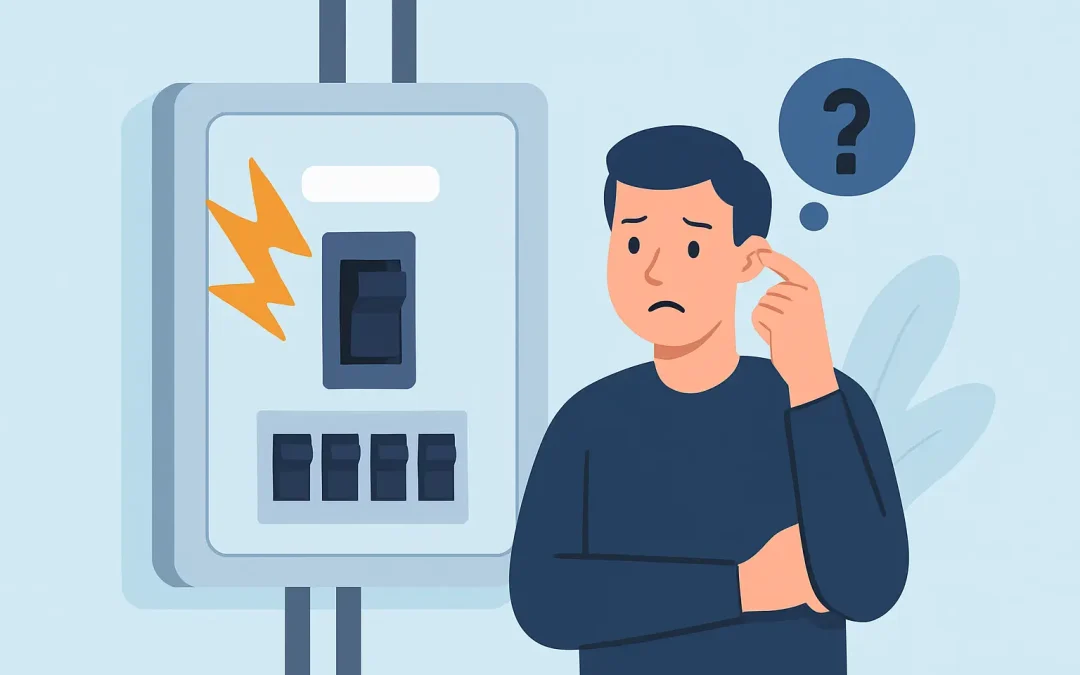
If your whole house suddenly goes dark – not just one room – and you find the big breaker in your electrical panel sitting halfway between ON and OFF, your system is doing exactly what it was designed to do: shut down before something overheats.
That’s the part many homeowners and business owners don’t hear often enough. A main breaker trip is not “annoying.” It’s a safety event. The right next step is figuring out whether you’re dealing with a temporary overload or a condition that can damage equipment, melt wiring, or start a fire if it’s repeatedly forced back on.
What the main breaker actually protects
Branch breakers protect individual circuits – the kitchen outlets, the bedroom lights, the garage receptacles. The main breaker protects the service feeding your entire panel. When it trips, it’s responding to a problem big enough (or close enough to the service equipment) that shutting down one circuit isn’t enough.
Main breakers trip for two broad reasons: too much current for too long (overload) or a dangerous abnormal condition (short circuit or ground fault) that spikes current fast. Heat also matters. Even a “normal” load can trip a breaker sooner when the panel is hot, the breaker is aging, or connections are loose.
Main breaker keeps tripping: the most common causes
There’s no single culprit, but there are patterns we see again and again in Rancho Cucamonga and across the Inland Empire – especially in homes that have been upgraded room-by-room while the electrical service stayed the same.
1) You’re exceeding what the service can handle
This is the classic scenario: everything seems fine until the oven is on, the dryer is running, and the AC kicks on. Add an EV charger, a spa, or even a portable heater in winter and the main breaker becomes the “weak link” that protects the service from overheating.
Two things make this more likely:
First, older services were not designed for today’s loads. A 100-amp service that worked great for a mid-century home can struggle when you add larger HVAC equipment, more kitchen appliances, and modern electronics.
Second, load doesn’t have to be extreme to be problematic. A sustained, near-limit load can warm the main breaker over time. It may not trip instantly. It might trip 20 minutes into cooking dinner.
2) A short circuit or fault in the panel or service equipment
If the main breaker trips immediately when you reset it – or it trips with a sharp pop, a flash, or a smell – treat that as urgent. A fault could be in the panel bus, the main breaker itself, the meter/main combination (common on some properties), or a feeder connection.
This is not a DIY “trial and error” situation. Repeatedly resetting a breaker into a fault can create more heat and damage.
3) A failing main breaker
Breakers are mechanical devices. They wear. They can become overly sensitive with age, or they can develop internal damage from previous overheating events.
A failing breaker can mimic an overload. You’ll see nuisance trips even when you’re not doing anything unusual, or trips at loads that used to be fine. The tricky part is you can’t reliably diagnose this just by looking at it. It takes testing, load evaluation, and inspection of the panel and connections.
4) Loose connections and heat buildup
Loose lugs, loose neutral connections, corrosion, or damage at the main terminals can create resistance, which creates heat. Heat changes how a breaker behaves and can lead to trips. It can also lead to arcing – which is exactly what you don’t want inside service equipment.
Sometimes the signs are subtle: occasional flickering lights, a faint burning odor, or a panel that feels warmer than it should. Other times there are no symptoms until the breaker trips.
5) Heavy loads on one leg in a split-phase system
Most homes have 120/240V split-phase service. If loads become unbalanced or there’s an issue with a connection, one “leg” can end up doing more work. You might notice some rooms getting dim when equipment starts, or certain appliances acting strangely.
This is one reason a professional load assessment matters. It’s not just how many amps you use – it’s how that load is distributed.
6) Water intrusion, pests, or environmental damage
Inland Empire heat, dust, and occasional moisture issues can all take a toll, especially on exterior panels or meter/main equipment. Water where it shouldn’t be can create tracking and corrosion. Rodents can damage insulation. Either can lead to fault conditions that trip the main breaker.
If you ever see moisture staining, rust, or signs of pest activity around the service equipment, don’t wait for “one more trip.”
What you can safely do right now (and what you should not)
When the main breaker trips, the goal is to reduce risk first, then gather useful information. You do not need special tools to do the safe steps, and you should avoid anything that exposes you to live parts.
Safe steps that help
Start by turning off or unplugging high-demand appliances and devices. Think HVAC, ovens, dryers, space heaters, portable AC units, and EV charging. If you’re in a business space, shut down non-essential loads like copiers, breakroom appliances, and supplemental heating/cooling.
Next, reset the main breaker correctly. Move it firmly to OFF, then back to ON. If it holds, bring loads back gradually. If it trips again when you turn on a specific appliance, that’s valuable information.
If the trip happens only when multiple appliances run together, that points toward an overload or service capacity issue. If it trips immediately with most loads off, that points toward a fault or a failing main breaker.
What not to do
Don’t “hold” the breaker in the ON position. Don’t reset it repeatedly hoping it will stay. Don’t remove the panel cover. Even with the main off, parts of the service equipment can remain energized.
If you smell burning, see scorching, hear buzzing, or notice the breaker will not reset, stop and call a licensed electrician.
When it’s an emergency
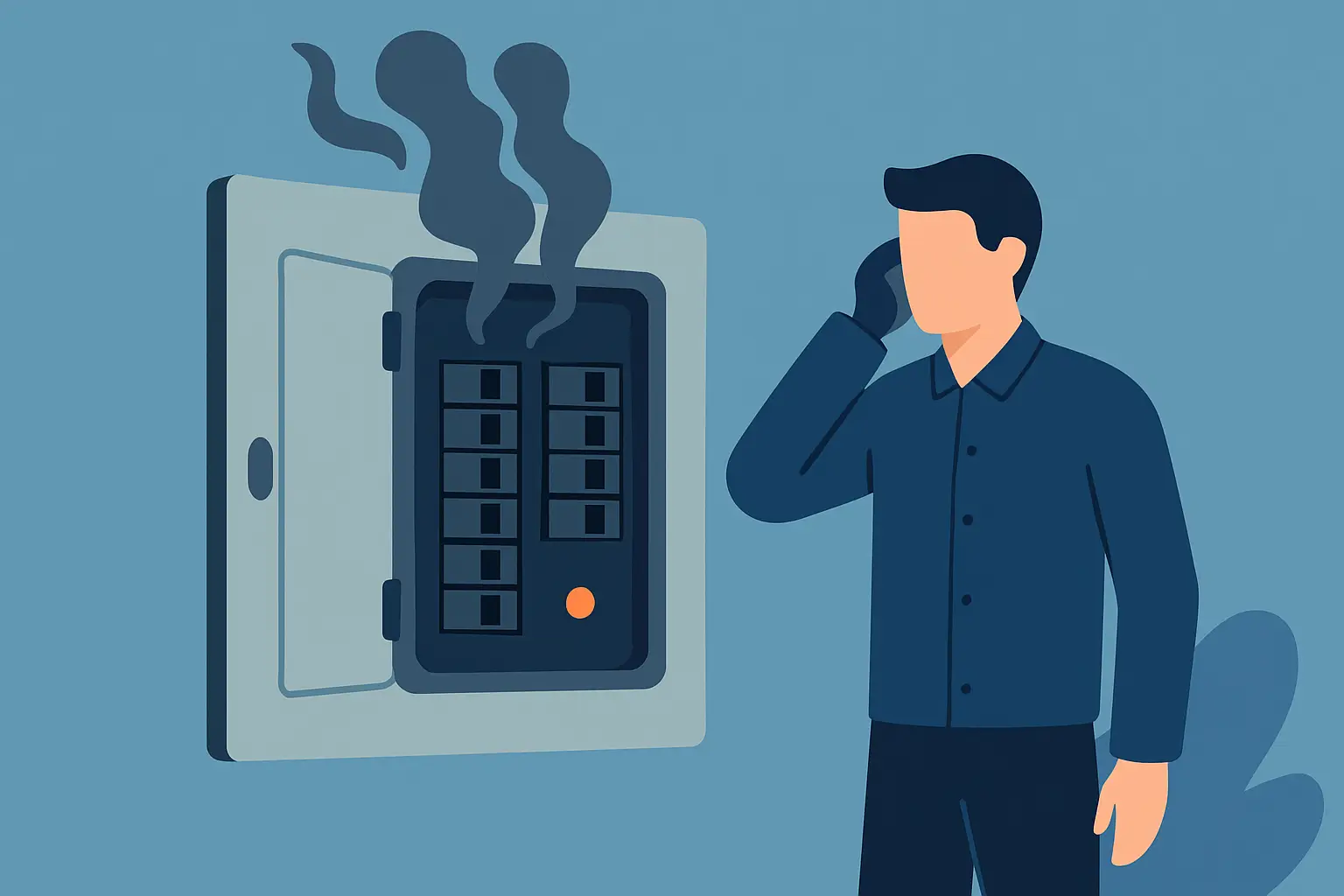
Some situations are a same-day call, not a “we’ll keep an eye on it.” If any of the following are true, treat it as urgent: the breaker trips instantly every time; you see smoke or scorch marks; you smell burning plastic; the panel is hot to the touch; you hear crackling/buzzing from the panel; or lights are flickering across the building in a way that suggests a service connection problem.
It also becomes urgent if critical equipment is impacted – medical devices at home, refrigeration for a business, server rooms, or security systems.
How a licensed electrician will diagnose the issue
A good diagnosis is not guessing, and it’s not swapping parts until something works. It’s a structured process that protects your equipment and your property.
First comes a visual inspection of the panel, service equipment, and any obvious contributors like melted conductors or signs of overheating. Then comes load evaluation. That may include checking actual current draw during typical operation, identifying which appliances are running when trips occur, and evaluating how loads are spread across the panel.
From there, the fix depends on the root cause. Sometimes it’s tightening and correcting terminations and addressing heat damage. Sometimes it’s replacing a failing main breaker or upgrading a panel that’s reached the end of its safe service life. Sometimes it’s adding dedicated circuits or using load management so major equipment doesn’t stack up at the same time.
The trade-off is straightforward: the cheaper option is not always the safer option. If your service is undersized for your real-world demand, you can keep “managing” loads for a while, but you’ll keep living with a system that’s operating on the edge.
Common fixes (and what they actually solve)
If your main breaker keeps tripping due to overload, the long-term solution is often a service or panel upgrade sized to your current and future needs – especially if you’re adding an EV charger, a heat pump, or an addition.
If the issue is a specific appliance, the fix may be repairing or replacing that appliance, or providing a properly sized dedicated circuit where required.
If the culprit is a failing breaker or damaged connections, replacement and corrective work in the service equipment can restore reliability – but only if the underlying overheating or corrosion problem is addressed at the same time.
And if you’re in a commercial space, minimizing downtime matters. Planning the work, staging materials, and coordinating shutoffs is often the difference between a smooth repair and a disruptive day.
Getting back to reliable power, safely
If you’re in Rancho Cucamonga or elsewhere in the Inland Empire and you want a clear, safety-first diagnosis, Potter Electric Company Inc. can help you get answers quickly and schedule repairs or upgrades without the runaround.
A main breaker trip is your electrical system waving a red flag. You don’t have to panic – but you do want to respond like it matters, because it does.
Take the next trip as a prompt to get the right fix, not just the fastest reset. You’ll feel the difference every time you flip a switch and everything stays on.